
Post Molding Inserts
Post Moulding Inserts
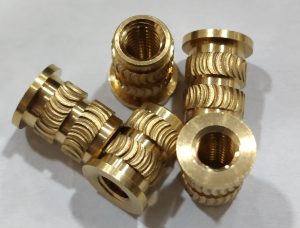 Brass Moulding Inserts can also be installed post moulding. These special inserts use heat, ultrasonic vibrations or press in method.
These brass inserts for plastic include external ridges and knurls, ensuring the insert remains locked in place when melted or pressed into the material. By distributing fastening loads across a metal surface rather than direct plastic threads, they help minimise the risk of stripped threads or damaged components.
As many products are being produced using 3D printing technology, the need for inserts that can be used after molding or printing has become very important.
Heat Set Inserts
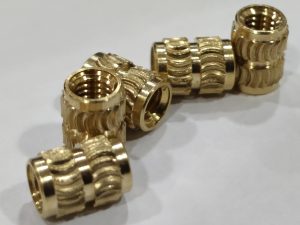 The heat set inserts feature rounded knurling thereby reducing the stress on the plastic.
Available in flanged (with collar) and captive (without collar) types.
BENEFITS
- The characteristics of these inserts generate low levels of stress on the surrounding material, making them ideal for amorphous thermoplastics.
- Symmetrical profile facilitates automated installation.
- High torque resistance.
- Self-aligning – easy to install.
These inserts are designed for heat staking, rather than ultrasonic welding, because direct heat is better at getting the plastic to flow into the knurled pattern of the insert.
Once installed and cooled, the heat press threaded inserts create a solid anchor point for additional threaded components. This method is particularly popular for 3D printing threaded inserts since it reduces the risk of threads stripping in delicate prototypes.
Post Moulding Inserts Heat-Set Brass D4C07-1 – Download Catalogue
Sonic Set Inserts
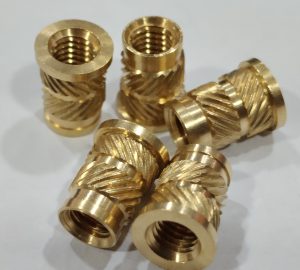 These inserts designed for quick installation in thermoplastics by heat staking or ultrasonic welding. It features two bands of opposing knurl patterns to provide a combination of both high torque and pull-out resistance. Available in captive and flanged versions.
Benefits
- Allows for thin walls so that the overall structure may be more compact.
- High torque and pull-out resistance.
- Quick installation by heat staking or ultrasonic welding.
- Wide range of lengths available.
- Self-aligning – easy to install.
INSTALLATION
The fastener may be installed by preheating the insert or by ultrasonic welding, which heats by way of vibration. When preheating the insert, be sure that the fastener softens the plastic without melting it. This will prevent unsightly defects around the upper edges of the insert. Ultrasonic welding is most effective when using low-amplitude vibrations and the lowest power that results in a sufficient softening of the plastic. In either case, avoid applying too much pressure, as this can result in forcing the insert into the hole without allowing the plastic to soften and flow properly into the knurling pattern on the insert.
Post Moulding Inserts Sonic-Set Brass D4C07-2 – Download Catalogue
Press Set Inserts
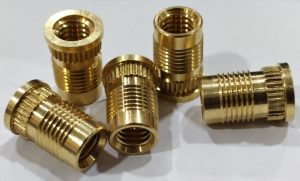 Press fit inserts are pressed into a component shortly after it has been molded. It features a combination of sharp fins and straight knurls. Unlike the slotted inserts, this insert has a free-running thread. Also available in stud and flanged versions.
BENEFITS
- Easy press-in installation.
- High pull-out resistance in most thermoplastic materials.
- Free-running thread.
- Self-alignment facilitates installation.
INSTALLATION
The insert is to be installed using a squeeze-action press. Using a hammer strike will inhibit plastic flow and could damage the boss.
Post Moulding Inserts Press-Fit Brass D4C07-3 – Download Catalogue
Design Guide
PREPARING THE HOLE
Molded holes are recommended whenever possible. The conical shape of a molded hole should not exceed 1°, and the recommended hole diameter is as measured at the level of the hole reached by the end of the insert. The upper part of the hole must not be rounded or chamfered, and be careful to avoid flaring. Hole diameter tolerance: -0.00 + 0.10 mm.